

Health Professions Education
Master of Education in Health Professions Education (M.Ed.)
Graduate Certificate in Teaching and Learning in Health Professions Education (G.Cert.)
Graduate Certificate in the Scholarship of Teaching and Learning (G.Cert.)
The Health Professions Education online graduate programs are intended for health professionals in medicine, nursing, dentistry, public health, rehabilitation science, veterinary medicine, and pharmacy and nutrition. These programs aim to enhance participants' educational knowledge, teaching expertise, and scholarly practice, preparing them to assume effective and innovative leadership in health professions education. Students can apply take one or both of the graduate certificates, or apply to the Master of Education in Health Professions.
Why Study Health Professions Education at USask?
- Designed to allow students to continue working full-time while pursuing coursework.
- All classes are offered online.
- Can be completed in two years.
- Students may begin studies in one of the graduate certificate programs and ladder into the full M.Ed. degree.
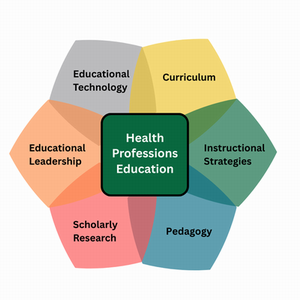
Across all six pillars, the program is unified by a focus on developing health professionals as reflective, scholarly educators. Learners build strong theoretical foundations in pedagogy, translate those foundations into effective instructional strategies, and design coherent curricula supported by educational technologies. Scholarly research and educational leadership connect practice to evidence and systems, enabling graduates to both improve their own teaching and contribute to meaningful educational change.
Educational Technology
Educational technology focuses on the purposeful use of digital tools and learning environments to enhance teaching, learning, and assessment in the health professions. Learners explore online and blended course design, simulation, educational media, learning management systems, and emerging technologies such as artificial intelligence. Emphasis is placed on making informed, pedagogically grounded decisions that support accessibility, engagement, and meaningful learning across diverse professional contexts.
Curriculum
The curriculum pillar centres on the design, alignment, implementation, and evaluation of curricula in health professions education. Learners examine outcomes‑based education, competency frameworks, accreditation standards, and curriculum mapping, with attention to coherence across courses, programs, and learning environments. This pillar supports educators in developing curricula that are responsive to learners, professional expectations, and evolving health system needs.
Instructional Strategies
Instructional strategies address the practical approaches educators use to facilitate learning in classroom, clinical, and virtual settings. Learners engage with a range of teaching and assessment methods, including active learning, feedback, simulation, workplace‑based education, and interprofessional learning. Emphasis is placed on selecting and adapting strategies that promote learner engagement, skill development, and learning transfer to professional practice.
Pedagogy
Pedagogy focuses on the theoretical foundations that inform teaching and learning in the health professions. Learners explore adult learning theory, social and constructivist perspectives, equity‑oriented and culturally responsive approaches, and learner‑centred education. This pillar supports educators in making intentional, reflective, and evidence‑informed pedagogical choices that align with their values, learners, and contexts.
Scholarly Research
The scholarly research pillar supports learners in critically engaging with and contributing to research in health professions education. Learners develop skills in research design, qualitative and quantitative methods, ethics, program evaluation, and knowledge translation. Scholarship is positioned as an integral part of educational practice, supporting innovation, improvement, and informed decision‑making.
Educational Leadership
Educational leadership focuses on leading, influencing, and sustaining educational initiatives within academic, clinical, and health system environments. Learners explore leadership theory, change processes, faculty development, mentoring, and systems thinking. This pillar prepares educators to navigate complexity, support colleagues and learners, and contribute thoughtfully to educational and organizational change.
The through line is the preparation of health professionals as reflective, scholarly educators who can design, enact, study, and lead meaningful learning in complex systems.
Each pillar represents a different lens on the same core work:
-
Pedagogy explains how and why learning happens
-
Instructional strategies translate that understanding into day‑to‑day teaching practice
-
Educational technology extends and supports learning across digital and hybrid spaces
-
Curriculum situates teaching within coherent programs and systems of learning
-
Scholarly research supports evidence‑informed practice and inquiry
-
Educational leadership connects individual expertise to organizational and system‑level change







Important Dates
Applications:
- Applications open: September 2026
- Application Deadline: April 1, 2027
- Decisions will be made within 3 weeks after the application deadline.
Academic Terms:
- Fall Term: September to December
- Winter Term: January to April
- Spring Term: May to July
- Review the academic calendar for more information: https://students.usask.ca/academic-calendar/index.php
Course registration:
- June: registration opens for the fall and winter terms.
- February: registration opens for the spring term.
- Add/drop deadlines can be found on the academic calendar: https://students.usask.ca/academic-calendar/index.php