Event celebrates student research at the College of Education
On Saturday, April 2, the College of Education hosted it's annual Celebration of Research, Scholarly and Artistic Work event for students.
The virtual event showcased the rich and diverse work of the graduate and undergraduate students in the College of Education and was open to all graduate students, as well as 4th Year undergraduate students enrolled in courses with a research component.
Students submitted posters, videos and infographics showcasing their research, which were available for viewing in advance of the event. On April 2, 15 students took part in the live Zoom event where they had three minutes to outline their research and seven minutes for questions and answers from the audience of faculty, staff and fellow students.
The virtual format helped international students in Bangladesh, Jamaica, India and Ghana access and participate in the event.
This year's award recipients included:
Top research poster
- Kacia Whilby, Department of Educational Administration, Fostering the Academic Transition of International Students Who are Ethnoculturally and Linguistically Diverse in Postsecondary Education
- Abstract: The need for more services and support for international students' academic transition is evident as their population continues to increase in postsecondary institutions. There is also a need for faculty to have a deeper understanding of how international students transition academically and how they can use the knowledge to guide academic support development. This phenomenological study examined the personal experiences of international students who are ethnoculturally and linguistically diverse (ECLD) with academic transition to postsecondary education.
- Poster

Top research infographic
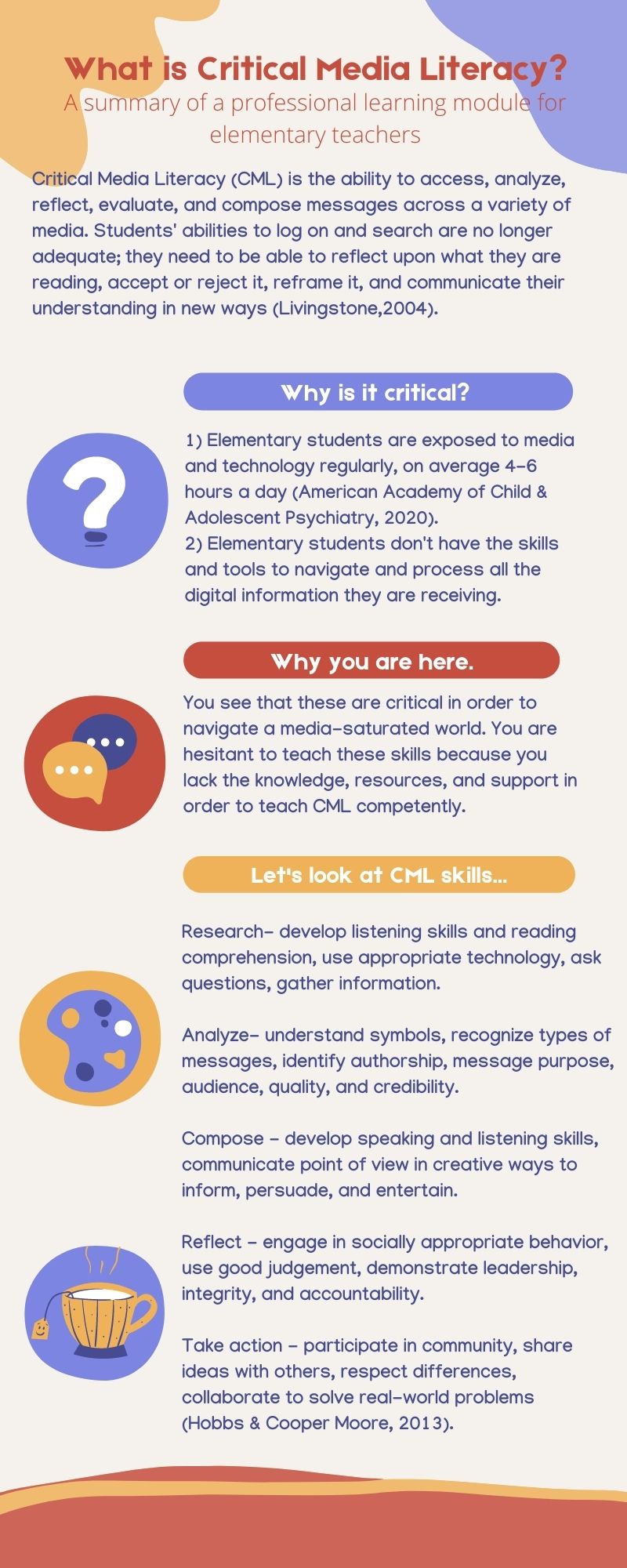
- Denise Lemay-Moore, Department of Curriculum Studies, Teacher Perspectives of Critical Media Literacy: Is It “Critical” in the Elementary Classroom?
- Abstract: As a response to a growing recognition of the need for critical media literacy skills, educational institutions have included critical media literacy (CML) outcomes within curriculums across Canada. However, its placement as an additional topic of study or embedded in language curriculums for elementary students, diminishes its priority. This module for professional development examines elementary teachers’ perspectives of CML in Alberta, how they understand it and their frustrations and comfort levels in teaching it. The module offers a foundational understanding of CML, the skills associated with it, and lessons for classroom use in Divisions 1 and 2.
- Infographic
Top research video
- Brent Olson, Educational Technology and Design, Department of Curriculum Studies, High School Theatre in Immersive Virtual Reality
- Abstract: Immersive virtual reality (IVR) has substantial possibilities for students to learn remotely through exploration, collaboration, and socialization. IVR is well suited to theatre, which relies on interpersonal attributes to demonstrate actor relationships and character development. IVR theatre can break down the fourth wall to connect audience members and actors in the same physical space, thereby removing the barrier of the stage and placing the audience within the storyline.
- In this study, a high-calibre youth theatre group was tasked with writing, workshopping, directing, rehearsing, and performing a play for a live studio audience in AltspaceVR. Grounded by current literature on the affordances and limitations of IVR, this research studied high school students imagining, designing, and delivering an immersive theatrical performance. Findings report how youth are experimenting with immersive technologies to take traditional theatre in new directions, including audience interaction, responsive narrative, and actors/actresses performing as digital avatars.
- Video
Top presentation (early research)
- Zain Japanwala, Department of Educational Psychology and Special Education, Teacher Perceptions of an Online Training Module for Accommodations of Students with Mathematical Learning Disabilities
- Abstract: Prevalence of students with specific mathematical learning disabilities (MLD) is estimated to be as high as 10% (Swanson et al., 2018) in schools today. It is therefore vital that general education teachers have the necessary training to help them become knowledgeable and comfortable with the use of accommodations for these students. The proposed study will pilot a newly developed online training module for MLDs with elementary school teachers which will then be evaluated for its efficacy through the use of structured interviews and think-aloud protocol. This study will provide essential insight about the components required for creating effective teacher training programs.
- Infographic

Top presentation (completed research)
- Leana Bacon, Department of Curriculum Studies, Resources for Learning Métis Culture & History
- Abstract: Many of the western provinces include some of the Traditional Homeland of the Metis, and yet, the Metis perspectives, culture and stories have rarely been a part of provincial curriculum. Not only does this presentation provides important and factual knowledge about the Metis people and their history and resilience, but it also includes a look at my process of research around the Metis and how they might be represented. Through this research, the hope is to provide more specific information and details surrounding the Metis Peoples to aid classroom teaching and to push for more Metis inclusion in curriculum documents across the Metis Homeland.
- This research is a fluid document that will evolve with others contributing to make this information completer and more truthful. As a Metis woman, I hope that all people take the time to know and understand the history of the lands, and that future generations are more accurately informed about the Traditional Homeland of the Metis and the Metis people.
- Prezi
Thank you to all the presenters:
- Katie (MacDougall) Janzen, Department of Curriculum Studies, Teacher and Parent Perceptions and Experiences Using Strategies to Support Children with Exceptionalities’ Physical Activity Involvement
- Sana Aiman Jalgaonkar, Department of Educational Administration, Roadways to educational recovery: Covid 19
- Blessing Dwumah Manu, Department of Educational Administration, Investigating School Dropouts: A Case Study of Students in Junior High School of the WA Municipality, Upper West, Region, Ghana
- Chanel Thompson, Educational Technology and Design, Reimagining Immersive Learning in the Early Childhood Learning Environment
- Cynthie Gaetz, Educational Technology and Design, Immersive Learning Through VR in Elementary Science
- Fahmida Mazid, Department of Educational Administration, Examining Teacher Leadership and Practice in Bangladesh
- Lecia Ellis, Department of Educational Administration, International Student Graduates’ Workforce Integration in Saskatchewan: Three Sides to the Story
- Richard Nyarko, Department of Educational Administration, Workplace-Relational Wellbeing Damage Control: A Mixed Method Approach to Minimize Work-Related Distress Among Faculty
- Shua Her, Educational Technology and Design, The Perception of Online Education in a Pandemic
- Solomon Ahangba Menger, Department of Educational Administration,
Data-Driven Decision Making by Principals: A Phenomenological Study of Academic Achievement of Secondary Schools in Benue State, Central Nigeria