

Exploring literacies-in-context through a professional learning symposium
The Prairies Literacies Project hosted educators from across Saskatchewan for the Following the River symposium on April 17-18.
By Connor JayThe event offered an opportunity for educators to explore prairie literacies-in-context through multilingual and multimodal, land-connected experiences, guided by Elder Dr. Linda Young (BA’94, BFA’98, MEd’20, PhD’23).
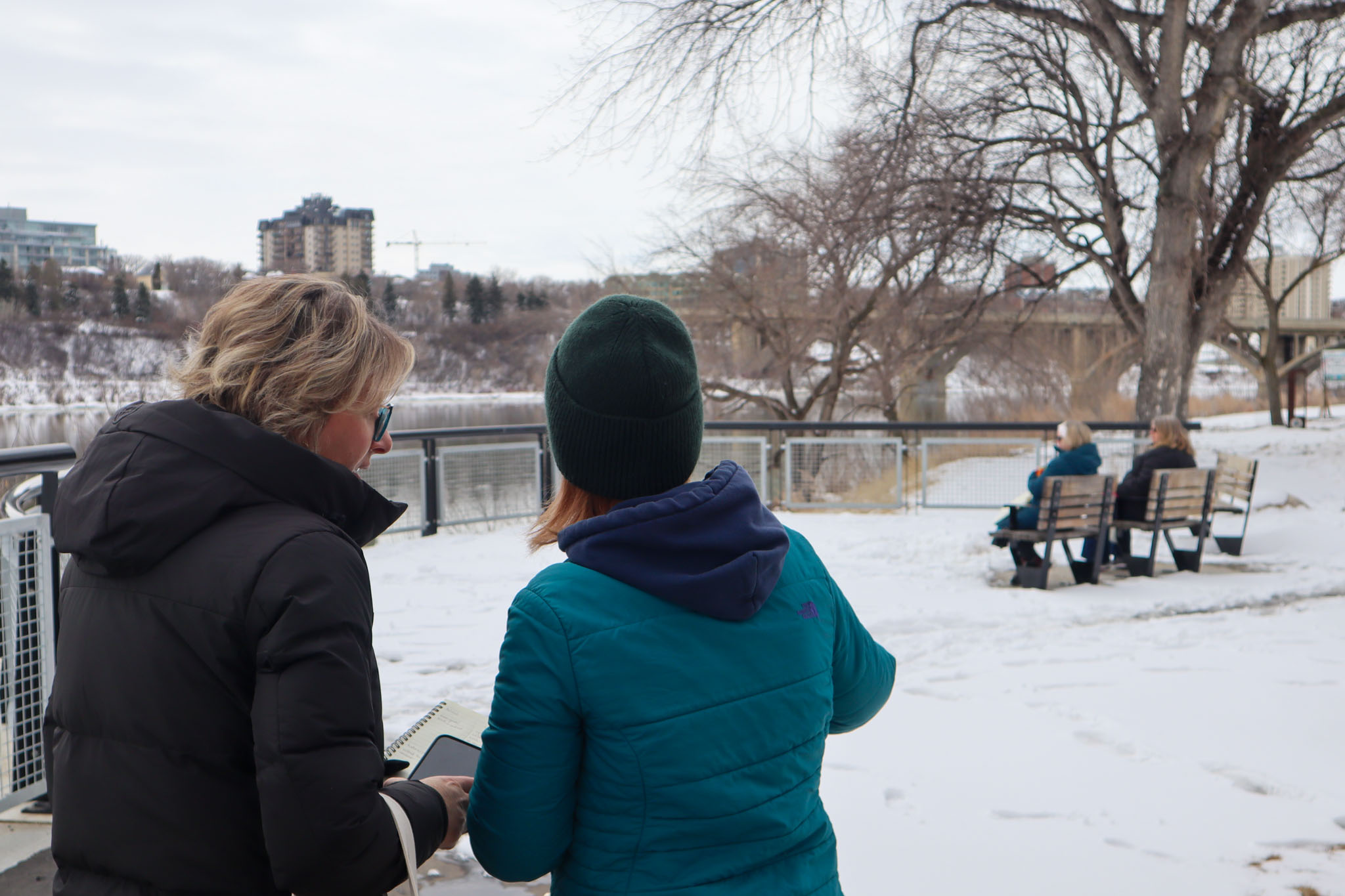
Dr. Lori McKee (PhD), an associate professor of curriculum studies at the University of Saskatchewan (USask), collaborated with colleagues from The King’s University, the University of Alberta, and the University of Manitoba to guide attendees through the theory and importance of literacies-in-context. The symposium began on April 17 with a tour of awâsisak kâ-nîmîhtocik St. Francis Cree Bilingual School and continued on April 18 with activities at the venue at McLean Block, walking and writing along the South Saskatchewan River, and art creation at Remai Modern. Each team member facilitated activities aligned with their specific expertise in literacies education.
McKee encouraged participants to teach literacies connected to place while using storytelling to share experiences and build connection.
“The teaching of literacies in relation to place is important as it confronts universal models of instruction and highlights the diversity of prairie literacies education,” McKee said. “Just like the river that flows in relation to the land, literacies are also dynamic and context responsive.”
Young opened the day with a prayer and shared ways to be mindful and follow proper protocol when experiencing place and the land.
“When you’re creating art, even if you go to the river and decide to do a landscape painting, you’re still taking from the land,” Young said. “It’s really important to offer protocol to give thanks to the earth, trees, water, or whatever it is that you’re taking from.”
To guide the educators, Young provided tobacco and pouches. By placing the tobacco in locations they were learning from, she said participants would receive what they needed from the land during their walk.
“I asked them to think about what they were doing on the walk and to put their intention in the pouch before placing it,” she said. “We take a lot of natural resources from this land. I’ve always felt that if companies followed protocol, they would know when to stop. The land needs to tell you when it can give again.
“I feel responsible, as an Indigenous person, that if I am going to support people to go and create artwork, they need to do it from that perspective.”
Co-lead Dr. Jennifer Watt (PhD) from the University of Manitoba (UManitoba) has co-facilitated similar walks and writing experiences in relation to place around the world with UManitoba colleague and symposium co-lead Dr. Michelle Honeyford (PhD). In all of these experiences, intentional noticing remains central.
“It’s about how we notice and what we need in a place,” Watt said. “When you do a literacies-in-context walk, it helps you notice things in a very different way than when you’re just talking or reading about it. Getting outside the classroom offers many opportunities to think about relationships and to decolonize education.”
Watt said educators can easily create effective writing prompts and reuse the same walking route, as the experience will always differ.
“When we do a walk, you can follow the same route, and every day it’s going to be different,” she said. “There was more ice in the river yesterday, so even that changes the experience. The more intentional you are in planning, the more confident you become.”
Educators of all experience levels learned from both the instructors and their peers. Graduate student Sam Roberts – part of the planning group – said she was excited to apply her artistic perspective in a new way.
“My art is usually photography and digital,” Roberts said. “I often get frustrated if I’m asked to draw, but it was encouraging to hear Linda talk about how it doesn’t have to be perfect and that you can keep working at it. That mindset of never being done really reflects teaching and learning.
“Today has been a wonderful experience to take part in the activities, expand my horizons and meet new people.”
Third-year undergraduate student Jarren Reaney said the experience reinforced his perspective as he begins his teaching career.
“Learning can happen anywhere,” Reaney said. “It doesn’t have to happen at a desk or in a classroom. The walk along the river, making art or talking with others might not feel like a direct lesson, but I’m still absorbing knowledge. I’m taking away the idea of being a lifelong learner, which is something we want to instil in our students.”