

Still not enough: USask educator's pursuit of equity
Paul Bazin Webster (MEd’12, EdD’24) watched the Kanesatake Resistance unfold on the news, and it became a foundational experience for him.
By Ashleigh MatternBazin Webster may have been young when the Oka Crisis played out in the media, but even then, it didn’t sit right with him.
News outlets portrayed the conflict between Kanyen'kehà:ka (Mohawk) protesters and Quebec police, the RCMP and the Canadian Army as if it were a war zone, framing it as “us versus them,” but ultimately the story was about the expansion of a golf course onto burial grounds.
“I couldn't even begin to understand how someone's perspective would ever allow for that to be justifiable,” Bazin Webster said.
Today, Bazin Webster is an assistant professor in Educational Administration at the University of Saskatchewan (USask) College of Education, and that early desire for equity and justice still drives him.
While he notes that significant developments have been made since the 1990s through curriculum, policy, and commitments from the Office of the Treaty Commissioner, it’s still not enough.
“I'm not satisfied with, at any moment, the idea of inequity and disparity in social, educational, and health realities for people based off of who they are foundationally as Indigenous or non-Indigenous [people],” he said.
He believes society can solve these hard problems and create harmony, well-being and nurturing spaces for all members of our community if we do the foundational things right — such as education.
One way he thinks significant change can be made is through the Doctor of Education (EdD) in Educational Leadership program.
The EdD program has four strands: Indigenous leadership contexts, international and comparative context, social justice and equity, and ethical leadership.
“If those four strands in the EdD program were able to touch every single educational leader in our province, our communities would be transformed,” Bazin Webster said. “It's time for effective and ethical leadership.”
Sharing language and culture

Teaching runs in Bazin Webster’s family. His mother launched the first French immersion program in Saskatoon Public Schools. A native French speaker born and raised in Saskatoon, Bazin Webster is Fransaskois, and he says his heritage and culture are a significant part of his identity.
“I like the idea of trying to share language and culture,” he said.
When it came time to choose a career, he was drawn to the idea of being a French immersion high school history teacher. That’s what he thought he was studying for when he completed his French immersion Baccalauréat en Éducation (Bachelor of Education) degree at the University of Regina.
“And then I never taught in a high school,” he said with a laugh. “I did my internship, and then I instantly got placed all over the place in an elementary context.”
His 20-year career as a teacher has led him in many directions, including launching an innovative Late French Immersion program, the first of its kind in Saskatchewan. It was a highlight of his career because he felt like he was following in his mom’s footsteps.
“I've been a teacher-librarian, a resource teacher,” he said. “I've taught all subject areas and all grade levels from kindergarten to Grade 12. If I count my internship, I've been a vice-principal, a consultant, and a program coordinator. So I've got division-based leadership experience and school-based leadership experience.”
He has also long been drawn to leadership roles. As a teacher, he enjoyed building powerful one-on-one relationships with students, and he saw that as a leader, he could have an even greater impact.
“I really liked the idea of being able to support and implement large-scale change,” he said.
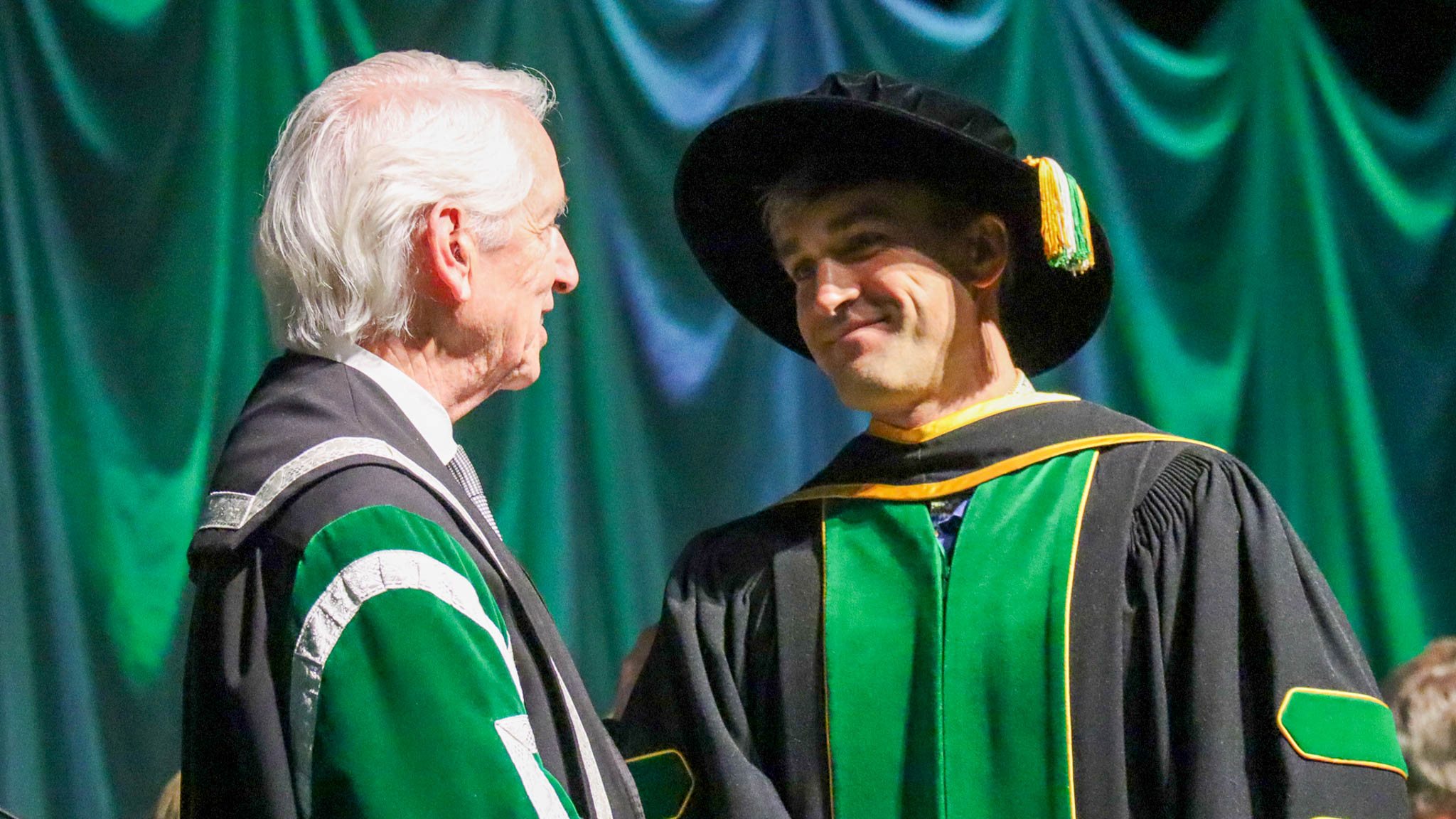
In 2024, he completed his EdD at USask. In the first chapter of his dissertation, he reflects on that early experience of watching the Kanesatake Resistance, and he says the work explores racism and notions of resistance to change.
The EdD program attracted him because it’s designed for working professionals. As a husband and father, the program’s structure also allowed him to prioritize family life.
“The EdD is such a powerful program,” Bazin Webster said. “It's a great opportunity for the people who register for it, but also for all of these different communities that the … graduates will touch.”
He looks at education leadership as a comparative and in an international context, trying to understand what’s offered in Saskatchewan that you can’t find elsewhere, and what the province does not yet have that it could benefit from.
“That was one of the strengths of my dissertation was looking outward,” he said. “To try and understand the relationship between Indigenous and non-Indigenous people, having equity-based policy for education and the promises that it holds, but also some of the complexities of the implementation and creating impact through that policy.”
Ripple effects
Bazin Webster began his assistant professor role in December 2025 and says the most exciting parts of his job are working with leaders and supporting research.
“The supervisory work within this role is really invigorating, because you're helping somebody else bring their passions to life.”
Within that teacher-student partnership, he says a shared investigation is sparked that creates a ripple effect.
“Working closely with somebody who's at this level of their educational journey, and also on the cusp of the type of impact that they will have in the professional or sectors that they're in, is actually really exciting.”
He has received 24 research statements from the 2025 EdD cohort, and he can’t wait to see what they discover.
“There are 24 amazing students that have … 24 independent points of inquiry that are about to get pursued in the next two years,” he said.
Those students will go out into their communities — whether in education, health, law, or policing — and, at the end of their education, to create positive change through the application of their experiences and what they learned.
When Bazin Webster was so deeply impacted by watching the Kanesatake Resistance, he may not have known then how he could affect meaningful change, but the desire to do so stayed with him throughout his life.
In his latest role as an assistant professor, he sees an opportunity to have a greater positive impact than in any of his previous roles.
But that doesn’t mean he has stopped being a student himself.
“If there's one thing I've realized through the various stages of my life is that the more I know, the less I know. … I hope I always have the privilege to learn."