

USask educators present experiential science fair to elementary school learners
More than 30 University of Saskatchewan (USask) College of Education teacher candidates presented at the Learning Centre Showcase to wâhkôhtowin School students on Nov. 26.
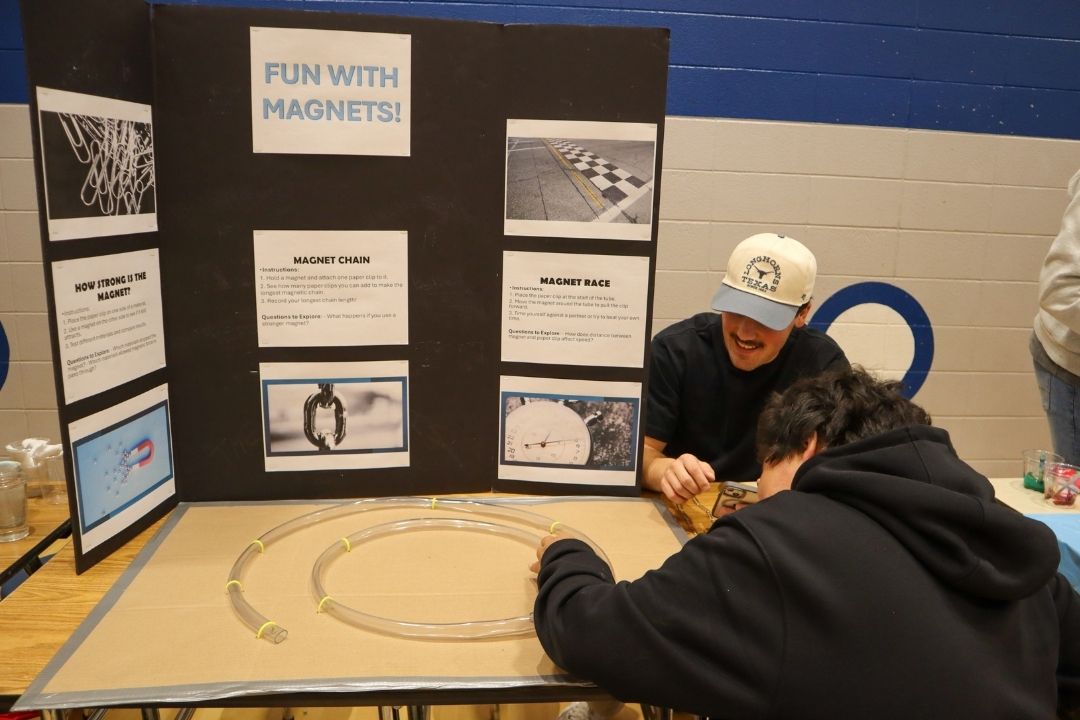
By Connor JayAs part of an assignment for their ECUR 322 course, the third-year teacher candidates were tasked with creating a science experiment that followed Saskatchewan’s school curriculum to present to students ranging from kindergarten through Grade 8. During the showcase, set up in the school’s gymnasium, staff and students browsed, learned, and interacted with the teacher candidates and their stations.
After the success of the Science and Human Psychology Inquiry Fair hosted by the college in March, Dan Krause, a lecturer in Curriculum Studies, wanted to achieve the same goal of connecting teacher candidates with local schools while providing a practical outlet to apply the theory studied in class.
“Equipping teacher candidates with methods to teach science to elementary students is a major goal of the ECUR 322 course,” Krause said. “For this assignment, teacher candidates needed to apply the theory in a practical setting, as they learned the importance of preparation when developing and delivering hands-on, experiential learning opportunities. By adjusting their communication and adapting their experiments to learners from multiple grades, teacher candidates experience teaching science on a smaller scale, scaffolding into their future Field Experiences in the College.”
Shalene Herron, principal of wâhkôhtowin School, said she was pleased with the hands-on learning opportunities for the elementary students.
“It’s always great when we have teacher candidates come in and practise their craft, learn about the curriculum and then bring it alive,” Herron said. “Science is one of those subjects that just comes alive when it’s hands-on. Today was a great day to have our kids engaged and learning hands-on with science. I’m super happy with the outcome today.”
Leyton Hiebert, Paige Pachkowski, and Carson Bell were among the teacher candidates who developed and presented science projects.
Structures — Leyton Hiebert
Hiebert’s project covered the main components of creating a structure, with a focus on the Grade 3 curriculum.
“A frame would be a structure made from parts joined together that has empty spaces, like a skeleton,” Hiebert said. “A shell would be a thin outer layer that protects the inside, like an igloo. And then a solid structure would be a piece or a block of materials that are packed together.”
Hiebert explained the strengths and weaknesses of each frame, shape, and material.
“I have been telling kids that triangles are the strongest because the weight is evenly distributed. They use triangles to make squares more sound. Domes, arches, and cylinders can also make the weight easier to bear for certain materials like wood, metal, plastic, and concrete.”
Students were quizzed on the knowledge and then used activity sheets to sketch blueprints and create their own structures.
“They were super engaged with the hands-on activities. They asked lots of questions. Most of the kids stayed here and kept building more structures. It’s cool to see all the different interactions and ideas that the kids create.”
Chain Reactions — Paige Pachkowski
Pachkowski explored chain reactions and movement using dominoes. Her station let students build and test different domino lines and runs to see what happens when one domino knocks into the next.
“If you push one domino into the next, it is called an energy transfer,” Pachkowski said. “When a domino is in motion it stays in motion, and that energy has to transfer from one domino to the other.”
Pachkowski had three domino run options for students to try: a basic straight line, a split path branching into a Y shape and a competitive setup combining dominoes with gears such as a bell or pendulum to see whose line would tumble the fastest.
“The kids came and got to experience each setup, have fun and explore science,” she said.
Oobleck — Carson Bell
Bell’s activity was hands-on as students played with Oobleck, a non-Newtonian fluid that can act as a solid or liquid. After teaching students about the three states of matter — solid, liquid and gas — he poured the cornstarch-and-water mixture into cups for students to explore.
“I gave the kids gloves and they’ve been hitting, rolling, pouring and figuring out all of the different ways you can use Oobleck,” Bell said. “They definitely got the hang of it and had a good time.”
Bell also demonstrated how the speed of moving Oobleck can affect its state, incorporating food colouring so students could see the substance mix or turn solid.
“You can take a stir stick and if you try to move it fast, it’s not going to move because it turns into a solid. But if you go slow, you can actually mix the Oobleck because it’s still in its liquid state.”
Together we will support and inspire students to succeed. We invite you to join by supporting current and future students' needs at USask.